
The Hidden Potential of the Classic Ranch
Imagine pulling into your driveway after a long day. Your eyes scan the horizon of your property, and instead of seeing just a flat, single-story building, you see a masterpiece of texture, color, and depth. This is the magic of well-executed landscaping for a ranch-style home. Often characterized by their long, low profiles and sprawling footprints, ranch homes—also known as ramblers—are a staple of American suburban architecture. While they offer fantastic accessibility and an open-concept interior, their exteriors can sometimes feel a bit “flat” or repetitive if the landscaping isn’t handled with care.
SUBMIT YOUR DETAILS FOR
If you own a ranch home, you possess a unique canvas. Unlike a towering Victorian or a compact colonial, your home stays close to the earth. This gives you a golden opportunity to blend your architecture seamlessly with nature. Improving the curb appeal of a ranch home isn’t just about planting a few flowers; it’s about creating a visual journey that breaks up the horizontal lines and highlights the charm of single-story living. In this guide, we will walk through a storytelling approach to transforming your front yard into an inviting oasis that neighbors will envy.
Breaking the Horizontal Monotony
The most common challenge with ranch-style architecture is the “long and low” look. Without the right plants, the house can appear to be sinking into the ground or stretching on forever. To counter this, we need to introduce verticality. Think of your landscape as a musical composition; if every note is the same, it becomes background noise. You need some high notes to create interest.
A great way to start is by incorporating ornamental trees that won’t overwhelm the roofline but will provide much-needed height. Consider a Japanese Maple with its delicate, colorful leaves, or a Serviceberry tree that offers white blooms in the spring and vibrant foliage in the autumn. Positioning these trees at the corners of the house or near the entryway helps “frame” the home, drawing the eye upward and breaking that continuous horizontal roofline.
The Power of Layering
In the world of professional landscaping, layering is the secret weapon. Instead of planting a single row of boxwoods along the foundation (which only emphasizes the long lines of the house), think in three dimensions. We want to create a foreground, a middle ground, and a background.
- The Background: This should consist of taller shrubs or small trees placed closest to the house. These hide the foundation and soften the transition between the siding and the soil.
- The Middle Ground: This is where you introduce texture and color. Mid-sized pereials like hydrangeas, hostas, or ornamental grasses work beautifully here.
- The Foreground: Closest to the walkway or lawn, use low-growing groundcovers, aual flowers, or creeping phlox to create a soft “edge” to your garden beds.
By staggering the heights and depths of your plants, you create a sense of movement. When you look at the house from the street, the garden feels lush and full rather than flat and two-dimensional.
Designing a Welcoming Entryway
Ranch homes often have a front door that is recessed or tucked away under a deep eave. From a distance, the entrance can get “lost” in the facade. To boost curb appeal, your landscaping should act as a giant arrow pointing guests toward your front door.
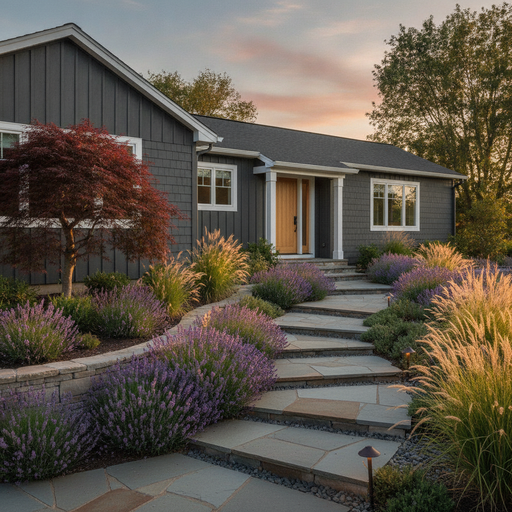
Start with the walkway. If you have a standard, narrow concrete path, consider widening it or replacing it with natural stone pavers or stamped concrete. A curved path is often more visually appealing than a straight one, as it mimics the organic shapes of nature and slows down the visual pace. Along this path, use “sentinel” plants—matching containers or upright shrubs—to flank the start of the walkway or the steps leading to the porch. This creates a formal “aouncement” that the entrance is here.
Lighting: The Nighttime Transformation
Curb appeal doesn’t stop when the sun goes down. In fact, ranch homes look stuing under the right architectural lighting. Because of their long silhouettes, you can use “up-lighting” on focal trees and “wash lighting” on the broad stretches of brick or siding to create a warm, sophisticated glow. Path lights nestled among your flowers ensure that your beautiful new walkway is safe and visible, guiding visitors with a soft, ambient light rather than a harsh security glare.
The Modern Foundation Garden
Gone are the days of the “meatball” shrubs—those perfectly round, overly sheared bushes that were popular in the 1960s. Modern ranch landscaping leans into a more natural, “boho-chic” or “modern-organic” aesthetic. Instead of stiff hedges, imagine a mix of textures. Pair the soft, wispy blades of Mexican Feather Grass with the bold, waxy leaves of a Magnolia shrub.
Focus on a color palette that complements your home’s exterior. If your ranch is a classic red brick, cool tones like blues, purples, and silvery greens (think Lavender, Russian Sage, or Blue Fescue) will pop beautifully. If your home is a modern gray or white, you can go bold with vibrant reds, deep oranges, and bright yellows to create a high-contrast, energetic look.
Hardscaping: Defining the Space
Landscaping isn’t just about plants; it’s about the hard elements that give the garden structure. For a ranch home, adding a small patio or a sitting area in the front yard can be a game-changer. Since many ranch homes are built on flat lots, creating a slightly raised stone planter or a low retaining wall can add much-needed architectural interest.
A stone wall also provides a functional benefit. It can level out a sloped yard, creating a flat “shelf” for a more formal garden bed. This adds a sense of “groundedness” and luxury to the property. Even a simple addition, like a birdbath or a large decorative boulder placed strategically within a mulch bed, can act as a focal point that breaks up the lawn and gives the eye a place to rest.
Sustainable and Low-Maintenance Beauty
One of the reasons people love ranch homes is the ease of maintenance—everything is on one level. Your landscaping should reflect that same philosophy. Xeriscaping or using native plants is an excellent way to ensure your curb appeal lasts year-round without requiring you to spend every weekend with a pruning shear or a garden hose.
Native plants are already adapted to your local climate and soil, meaning they require less water and are more resistant to local pests. Incorporating a thick layer of organic mulch or decorative river rock can help suppress weeds and retain moisture, keeping your garden looking tidy with minimal effort. Remember, the goal is to enjoy your home, not to be a slave to your yard.
Final Thoughts: Your Home’s First Impression
Your ranch home’s curb appeal is the first chapter of the story you tell your guests. It’s an invitation, a warm hug, and a reflection of your personal style. By breaking up the horizontal lines with vertical plants, creating a clear and beautiful path to your door, and layering textures and colors, you transform a simple house into a stuing estate.
Don’t feel like you have to do everything at once. Start with the entryway and work your way out. Each plant you put in the ground and each stone you lay is an investment in your home’s value and your own daily happiness. So, grab a pair of gloves, head outside, and start reimagining what your ranch home can truly become. The horizon is yours to shape.