
The First Impression That Lasts a Lifetime
Imagine you are walking up a beautifully manicured stone path, the scent of lavender lingering in the air, and the soft glow of architectural lighting guiding your way. You reach the threshold of a home, and there it is: the door. But it isn’t just any door. It is a towering masterpiece of solid mahogany with hand-forged bronze handles, pivoting effortlessly on a hidden axis. In that moment, before you even step inside, you know exactly what kind of home this is. You know the level of detail, the appreciation for craftsmanship, and the lifestyle of the people who live there.
SUBMIT YOUR DETAILS FOR
Luxury is often found in the details that most people overlook, but the exterior door is one detail that is impossible to ignore. It is the handshake of the home. As a custom exterior door design expert, I have seen how a single design choice can transform a standard facade into an architectural landmark. In this guide, we will explore the world of high-end custom doors, from the materials that define elegance to the technology that ensures your sanctuary remains private and secure.
Why Customization is the Ultimate Luxury
When we talk about luxury, we are really talking about “bespoke” experiences. Off-the-shelf solutions from big-box retailers might serve a functional purpose, but they lack soul. A custom luxury door is designed specifically for the proportions of your entryway, the architectural style of your home, and your personal aesthetic preferences.
Customization allows you to play with scale. In modern luxury design, “bigger is better” is a recurring theme. We are seeing more homeowners opt for oversized pivot doors that stand ten feet tall or wider than a standard double door. These massive structures create a sense of awe. Beyond size, customization gives you control over the grain of the wood, the finish of the metal, and the opacity of the glass. It is a functional piece of art tailored to your life.
Materials That Command Respect
The foundation of any luxury door lies in the materials used. In the world of high-end design, three categories reign supreme: exotic hardwoods, structural metals, and artisan glass.
The Warmth of Rare Woods
Hardwood remains the gold standard for luxury. However, we aren’t talking about standard pine or oak. Luxury doors often utilize:
- African Mahogany: Known for its deep reddish-brown hue and incredible durability against the elements.
- Black Walnut: A favorite for modern homes due to its rich, dark tones and intricate grain patterns.
- Teak: The ultimate choice for coastal properties, as its natural oils make it naturally resistant to moisture and salt air.
- Iroko: Often called “African Teak,” it offers a unique golden-brown color that matures beautifully over time.
The Strength of Steel and Bronze
For those seeking a more industrial or contemporary look, metal is the go-to. Cold-rolled steel doors with ultra-slim sightlines allow for massive panes of glass, blurring the line between the indoors and outdoors. Bronze, on the other hand, offers an “old world” luxury. A solid bronze door will develop a stuing patina over decades, telling the story of the home’s history through its changing colors.
The Rise of the Pivot Door
If there is one trend that has come to define modern luxury architecture, it is the pivot door. Unlike traditional doors that hang on hinges attached to the side of the frame, a pivot door rotates on a spindle at the top and bottom. This allows the door to support much more weight, enabling the use of heavy materials like solid stone or thick reinforced glass.
The movement of a pivot door is what truly makes it feel luxurious. Because the weight is distributed differently, even a 500-pound door can be opened with the light touch of a finger. It moves with a silent, hydraulic grace that feels more like a vault than a simple entryway. It is a statement of engineering as much as it is a statement of style.
Architectural Harmony: Matching the Door to the Home
A luxury door should never look like an afterthought; it must be an extension of the home’s DNA. Let’s look at how design styles dictate door choices:
Modern Minimalist
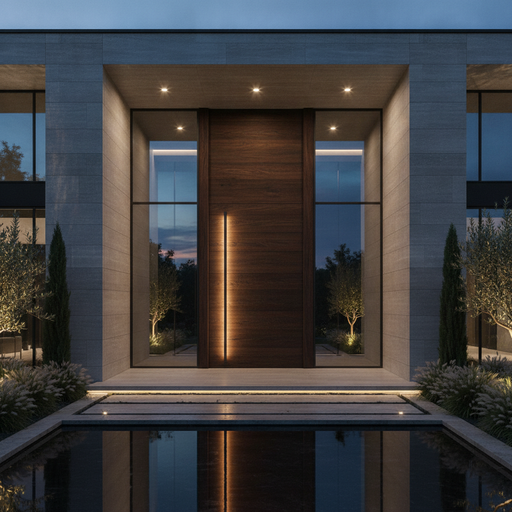
In minimalist architecture, the door often features clean lines and a lack of ornamental clutter. Think of a vertical-slat walnut door with a full-length recessed LED handle. The luxury here is found in the precision of the joinery and the quality of the finish.
Mediterranean and Spanish Revival
For these homes, we look toward heavy textures. Arched tops, hand-carved wood panels, and decorative wrought iron “clavos” (nails) or grilles. These doors feel grounded, heavy, and timeless. They evoke the feeling of a European villa that has stood for centuries.
Transitional Elegance
The transitional style bridges the gap between traditional and modern. These doors often use classic proportions but update them with modern materials, such as a traditional six-panel layout made entirely of matte black steel and reeded glass.
The Invisible Luxury: Security and Smart Integration
True luxury provides peace of mind. A custom exterior door today is more than just a barrier; it is a sophisticated security hub. High-end homeowners are increasingly moving away from traditional keys in favor of seamless biometric integration.
Imagine approaching your door and having a discreet fingerprint scaer embedded in the handle recognize you instantly. Or perhaps a facial recognition camera hidden in the portico unlocks the deadbolt as you walk up with groceries. These systems are integrated directly into the door’s construction, ensuring that the technology doesn’t detract from the aesthetic beauty. Furthermore, luxury doors often feature multi-point locking systems that secure the door at the top, bottom, and middle, providing bank-vault levels of security without compromising on style.
Environmental Resilience and Insulation
A common misconception is that a beautiful custom door must be delicate. In reality, a luxury door is engineered to withstand the harshest environments. High-end custom doors utilize “thermal break” technology, especially in metal designs, to ensure that the summer heat or winter chill stays outside. For wooden doors, specialized core constructions (such as LVL or specialized foam cores) prevent the wood from warping, shrinking, or expanding due to humidity. Investing in luxury means investing in a door that will function perfectly for fifty years, not just five.
The Finishing Touches: Hardware and Lighting
No custom door is complete without the jewelry—the hardware. In luxury design, hardware is often custom-cast. Large-scale pull bars made of leather-wrapped brass, knurled steel, or even semi-precious stones provide a tactile experience every time you enter the house.
Lighting also plays a crucial role. A luxury entrance isn’t just about the door itself but how it is presented. Symmetrical sconces, recessed soffit lighting, or even “uplighting” the texture of the wood can make the entrance feel like a gallery piece at night. When the light hits the grain of a custom-stained white oak door just right, it creates a glow that welcomes guests before they even reach the porch.
Conclusion: An Investment in Your Home’s Identity
Choosing a custom luxury exterior door is one of the most impactful decisions a homeowner can make. It is an investment that yields high returns in both property value and personal pride. It is the bridge between the public world and your private sanctuary. By combining the finest materials, cutting-edge engineering, and a clear architectural vision, you create an entrance that doesn’t just open a house—it introduces a home.
Whether you lean toward the massive, silent swing of a contemporary pivot door or the intricate, hand-carved details of a traditional mahogany masterpiece, remember that your door tells a story. Make sure it’s a story worth telling.