
The Siren Call of the Florida Shoreline
Imagine waking up to a symphony of soft, rhythmic waves crashing against a shore of sugar-white sand. You step out onto a private terrace, the salty Atlantic breeze tangling in your hair as the first golden rays of the sun paint the horizon in shades of saffron and violet. This isn’t just a vacation fantasy; for a growing number of discerning buyers, this is the daily reality of owning a luxury beachfront home in Florida. The Sunshine State has long been a magnet for those seeking warmth, but in recent years, the market for high-end coastal properties has transformed from a mere real estate trend into a full-blown cultural phenomenon.
SUBMIT YOUR DETAILS FOR
Florida’s coastline is more than just a geographic boundary; it is a lifestyle statement. From the neon-lit sophistication of Miami Beach to the quiet, understated elegance of Naples, the variety of luxury living options is as vast as the ocean itself. But what is it about this particular market that continues to defy economic gravity? To understand the allure, we have to look beyond the infinity pools and the designer kitchens. We have to look at the stories of the people moving here and the unique alchemy of factors that make Florida the ultimate destination for the world’s elite.
Two Coasts, Two Very Different Souls
When discussing Florida’s luxury market, it is essential to distinguish between the two distinct personalities of its coasts. On the East Coast, the Atlantic Ocean provides a backdrop of high energy and deep blue waters. Places like Palm Beach and Miami Beach are the epicenters of this “Gold Coast.” Here, luxury is often synonymous with architectural grandeur and social prestige. In Palm Beach, you find historic estates that whisper stories of the Gilded Age, where privacy is guarded by tall hedges and manicured lawns. Meanwhile, Miami’s “Billionaire’s Bunker” (Indian Creek) and Star Island offer ultra-modern glass fortresses that cater to tech titans and international celebrities.
Conversely, the Gulf Coast offers a different kind of luxury—one defined by tranquility and breathtaking sunsets. Naples and Sarasota have become the crown jewels of the West Coast. Iaples, particularly ieighborhoods like Port Royal, the luxury is “old money” refined. The water is calmer, the pace is slower, and the focus is often on boating and golf. The sand here feels like powdered sugar between your toes, and the sunsets are a nightly event that brings the community to a standstill. Choosing between the two isn’t just about the house; it’s about choosing the rhythm of your life.
Architectural Evolution: From Stucco to Seamless Glass
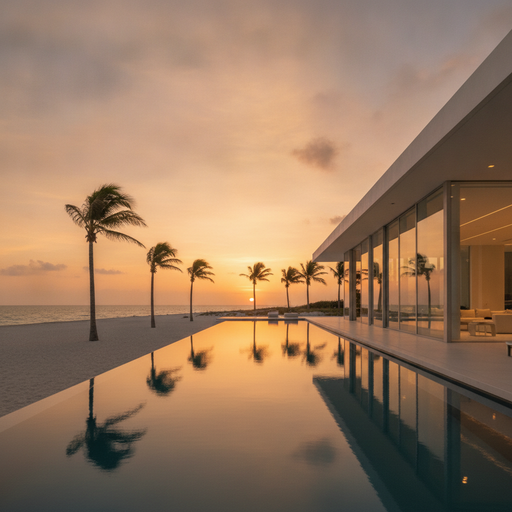
The design language of Florida’s luxury beachfront homes has undergone a radical transformation over the last decade. Gone are the days when heavy Mediterranean Revival—characterized by dark woods and thick stucco—dominated the landscape. Today’s high-end buyer craves “Organic Modernism.” This style emphasizes a seamless transition between indoor and outdoor living, utilizing massive floor-to-ceiling glass walls that disappear into pockets, effectively making the ocean a living piece of art inside the home.
We are seeing an incredible emphasis on “wellness architecture.” This includes integrated air purification systems, circadian lighting that mimics the natural path of the sun, and dedicated spa wings with cold plunge pools and infrared saunas. In the luxury sector, a home is no longer just a shelter; it is a sanctuary designed to optimize the health and longevity of its inhabitants. Furthermore, sustainability has become a status symbol. LEED-certified mansions with solar arrays and storm-resistant materials are increasingly in demand, as buyers look to protect their investments against the elements while maintaining a smaller carbon footprint.
The “Wall Street South” Effect
One caot discuss the Florida luxury market without mentioning the massive migration of wealth from traditional financial hubs like New York, Chicago, and San Francisco. This movement, often dubbed “Wall Street South,” has fundamentally shifted the market dynamics. Florida’s lack of state income tax has always been a draw, but the shift toward remote and hybrid work models catalyzed a permanent move for many executives and entrepreneurs.
This influx of high-net-worth individuals has created a “scarcity” mindset. There is only so much beachfront land available, and as demand skyrockets, prices have reached historic highs. It’s not uncommon to see “teardowns” selling for tens of millions of dollars—homes where the value lies entirely in the dirt beneath them. Buyers are willing to pay a premium for the security, the tax benefits, and the proximity to a burgeoning ecosystem of high-end dining, private social clubs, and elite schools that have followed the wealth south.
Investment Resilience in a Changing Climate
A common question from outsiders is how the luxury market remains so robust in the face of climate concerns and rising insurance costs. The reality is that the luxury tier operates on a different set of rules. For the ultra-wealthy, these homes are often part of a diversified global portfolio. They are willing to invest millions into “hardening” their properties—building on elevated pilings, installing industrial-grade seawalls, and using impact-resistant materials that can withstand the fiercest hurricanes.
Moreover, the Florida market has shown incredible resilience. History has shown that after every major storm or economic dip, the demand for beachfront property in Florida doesn’t just recover—it surges. The emotional pull of the water and the lifestyle advantages simply outweigh the perceived risks for many. For these buyers, the “risk” of missing out on a decade of sunsets and memories is far greater than the logistical challenges of coastal ownership.
The Hidden Gems: Beyond the Usual Suspects
While Miami and Naples steal the headlines, savvy investors are looking at Florida’s “hidden gems” where the luxury market is just begiing to ripen. Areas like Vero Beach, known for its low-rise buildings and “hamptons-esque” vibe, offer a more secluded version of coastal luxury. Further north, the beaches of Ponte Vedra and Amelia Island provide a more temperate climate and a sophisticated, Southern-charm atmosphere.
On the Panhandle, the communities along 30A—such as Alys Beach and Rosemary Beach—have created a unique architectural vernacular. With their white masonry and cobblestone streets, they feel more like the Grecian coast or a Caribbean village than a typical Florida town. These areas have seen some of the highest rates of appreciation in the country, proving that Florida’s luxury appeal extends far beyond its southern tip.
Conclusion: More Than Just Real Estate
At the end of the day, the luxury beachfront market in Florida isn’t just about square footage or high-end finishes. It’s about the feeling of peace that comes when you look out over an endless blue horizon. It’s about the convenience of having your yacht docked in your backyard, ready for a spontaneous trip to the Bahamas. It’s about a state that has embraced its identity as a global playground for the successful.
Whether it’s a modern glass villa in Miami or a serene estate iaples, these homes represent the piacle of the American Dream reimagined for the 21st century. As long as the sun continues to shine and the waves continue to roll in, Florida’s coastline will remain some of the most coveted real estate on the planet. For those who can afford it, the investment isn’t just in property—it’s in a life well-lived, measured in tides and golden hours.